
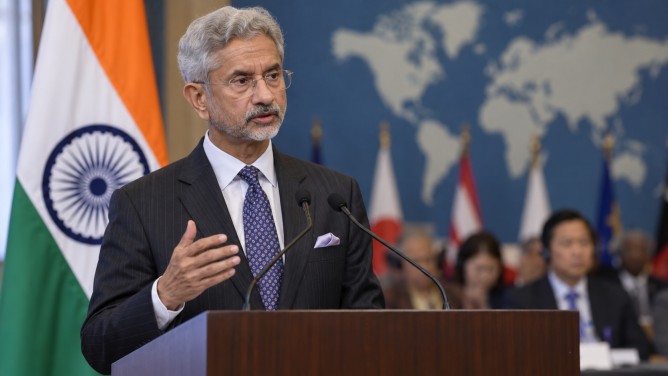
India is positioning itself as a formidable “middle power” on the global stage, bolstered by a population of 1.4 billion and an economy valued at approximately $4 trillion, according to External Affairs Minister S. Jaishankar. Speaking at the Bloomberg New Economy Forum alongside Canadian Foreign Affairs Minister Anita Anand, Jaishankar emphasized India’s increasing influence in shaping a new global order through strategic partnerships and independent policies.
Jaishankar’s remarks were centered on the rising prominence of middle powers amid geopolitical shifts and economic realignments. He noted that countries are reevaluating their national interests, leading to independent policy-making and collaborative efforts to tackle common challenges. Initiatives such as the Quad and the India-Middle East-Europe Economic Corridor (IMEC) were cited as examples of nations working together on strategic and economic priorities.
Highlighting a shift in global governance, Jaishankar suggested that more countries are seeking a significant role in international decision-making. This reflects a growing interest among emerging economies to enhance cooperation while maintaining strategic autonomy, a sentiment echoed by Canadian Prime Minister Mark Carney, who called for middle powers to protect multilateralism and adapt to changes in the international system.
Anita Anand reinforced this perspective by urging middle powers to adopt a proactive leadership role in shaping the international order. She emphasized the importance of protecting international rules, strengthening economic resilience, and addressing emerging security challenges. Anand pointed to Canada’s strategies, including trade agreements and security partnerships, as well as cooperation through multilateral platforms like the G7, as a model for coordinated action to support shared interests and resilient supply chains.
The dialogue underscored the critical role of collaboration among middle powers as they navigate increasing geopolitical tensions, economic uncertainties, and evolving global alliances. By engaging closely with one another, these nations can identify aligned interests and work collectively to influence the future direction of international affairs.